.png)

In machining procurement, achieving the perfect balance between cost, quality, and delivery often feels impossible. Buyers and procurement professionals face constant pressure to reduce prices without compromising performance or extending timelines. When production schedules are tight and budgets are fixed, it becomes critical to know how to balance cost, quality, and lead time in machining procurement to avoid disruptions and hidden fees that impact the entire supply chain.
This balancing act defines the success of any sourcing strategy for precision components. A supplier that is slightly more expensive but consistently delivers on time with minimal defects often saves far more than a low-cost vendor who struggles with rework or delays. Understanding the trade-offs between price, process capability, and capacity allows procurement agents to build resilient supplier networks that perform consistently and withstand market fluctuations.
The following insights explore practical methods for analyzing trade-offs, improving supplier collaboration, and structuring procurement processes that are efficient and reliable.

The Procurement Triangle: Cost, Quality, and Lead Time
Every machining decision is shaped by the relationship between cost, quality, and lead time, often referred to as the QCD (Quality, Cost, Delivery) triangle. These three elements are interdependent, meaning improving one typically affects the others.
- Lower cost might mean longer lead times, fewer inspections, or reduced flexibility.
- Faster delivery can require additional labor or premium shipping.
- Higher quality demands investment in skilled labor, advanced inspection, and preventive maintenance.
Procurement professionals who understand how to balance cost, quality, and lead time in machining procurement recognize that the best value comes from optimizing the entire QCD system, not just reducing prices. A data-driven approach to supplier evaluation ensures long-term stability and lower total ownership costs.
Looking Beyond Price: Total Cost of Ownership in Machining
The unit price on a supplier’s quote rarely tells the whole story. Total cost of ownership (TCO) accounts for all direct and indirect costs associated with a part, from order to end use. This includes shipping, inspection, rework, and downtime caused by late deliveries or nonconformances.
For example, consider two suppliers:
- Supplier A offers a low unit price but frequently delivers late, forcing you to expedite production.
- Supplier B charges slightly more but maintains 98 percent on-time delivery and consistent quality.
Over a year, Supplier B’s performance likely saves money by avoiding production delays, scrap, and re-inspections. Evaluating suppliers through a TCO lens helps procurement teams justify quality-focused decisions to management while meeting cost reduction goals.
To strengthen your TCO analysis, review the following areas:
- Changeover frequency is important since frequent setups increase labor time and cost.
- Material yield is achieved because efficient material utilization reduces waste and price variance.
- Lead time impact, as excess inventory or expedites create hidden holding costs.
- Supplier reliability, since consistent quality reduces inspection time and corrective action costs.
A supplier who understands these drivers and has the systems to manage them contributes far more value than one focused solely on price.
How Lead Time Impacts Quality and Cost
Machining lead time is influenced by part complexity, material availability, and scheduling discipline. When suppliers operate at full capacity, lead times can lengthen or fluctuate, creating uncertainty for procurement planning.
Shorter lead times can be achieved through improved communication and better planning between procurement and suppliers. This includes:
- Early forecasting and clear delivery schedules
- Consistent purchase volumes that support supplier planning
- Demand smoothing to minimize scheduling spikes
- Collaborative discussions on inventory buffers or kanban systems
Suppliers who adopt these lean production principles often deliver faster without sacrificing quality. Working with machining partners who emphasize preventive maintenance, cross-trained operators, and efficient tooling management can help significantly reduce machining lead time and increase throughput.
Understanding how to balance cost, quality, and lead time in machining procurement means identifying which variable drives business value for each project. A short turnaround may be essential for prototype development, while established products benefit more from quality stability and predictable pricing.

The Role of Supplier Collaboration
A strong supplier relationship is one of the most effective ways to manage QCD trade-offs. Procurement teams collaborating with machining suppliers early in the design and quoting process benefit from more accurate pricing, manufacturability insights, and realistic delivery schedules.
This is where Value Analysis and Value Engineering (VAVE) add measurable value. Involving suppliers during the design phase allows for input on material choices, tolerance adjustments, and process optimization, reducing unnecessary cost and time.
Collaboration also improves RFQ accuracy. Suppliers can allocate machine capacity and materials more efficiently when buyers share demand forecasts, part usage data, and preferred shipment frequency. The result is reduced queue time, improved pricing consistency, and fewer rush requests.
Additionally, early collaboration allows both sides to align expectations on inspection methods, documentation, and delivery cadence. This reduces back-and-forth clarifications and accelerates approval processes. A trusted partner such as Swiss Machine Products provides transparency that helps procurement teams plan effectively and manage schedules more confidently.
Quality as a Non-Negotiable
Quality cannot be traded for cost savings or shorter lead times for regulated industries such as medical, aerospace, and defense. Quality failures lead to returns, customer dissatisfaction, and potential compliance violations.
Procurement teams should assess supplier quality not only through inspection data but also through machining quality KPIs, such as:
- First Pass Yield (FPY)
- Cost of Poor Quality (COPQ)
- On-time delivery rate
- Corrective Action Response Time
- Customer return frequency
Suppliers who invest in continuous improvement and maintain detailed quality control plans provide long-term value that outweighs temporary price advantages. When evaluating potential partners, prioritize those with ISO-certified systems, advanced inspection capabilities, and a demonstrated record of corrective and preventive action success.
Managing Trade-Offs: When to Prioritize Each Factor
Procurement professionals must evaluate when to prioritize cost, when to focus on lead time, and when to emphasize quality.
- Cost-first sourcing works for non-critical parts, prototype testing, or low-risk assemblies.
- Quality-first sourcing is essential for critical-to-function components, validated assemblies, or any part impacting safety or compliance.
- Lead time-first sourcing becomes critical for urgent repairs, spare parts, or bridge production between manufacturing phases.
Establishing clear sourcing criteria ensures consistency and helps prevent reactive decision-making. This approach defines how to balance cost, quality, and lead time in machining procurement across your purchasing strategy and keeps decisions defensible under audit or review.
Reducing Risk with Dual Sourcing and Data-Driven Metrics
Relying on a single supplier for all machined components increases risk. A dual sourcing strategy, where production is shared between two qualified suppliers, reduces dependency and protects against capacity or equipment issues.
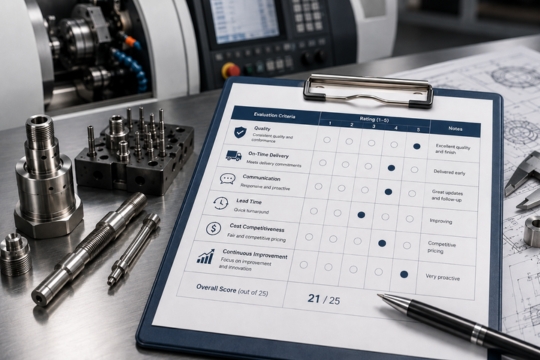
Procurement teams should manage suppliers using consistent, data-driven scorecards that track:
- Cost variance and delivery performance
- Nonconformance rate per shipment
- Responsiveness to RFQs and change orders
- Capacity and schedule adherence
Analyzing these KPIs quarterly allows procurement teams to identify patterns in delivery accuracy and pricing trends. This data enables fact-based decisions that reduce reliance on instinct or short-term urgency. Over time, this structured approach improves stability and strengthens your supplier network.
The Impact of Communication and Specification Clarity
Many procurement challenges stem from incomplete or unclear communication. Missing GD&T details, vague tolerances, or inconsistent revision control can lead to inflated costs and delayed timelines.
To improve outcomes:
- Submit complete RFQs that include tolerance ranges, materials, and finish requirements.
- Specify delivery frequency and shipment sizes early.
- Provide CAD models and encourage DFM (Design for Manufacturability) input from the supplier.
Suppliers who understand the intended application can quote accurately and design more efficient manufacturing plans. Clarity at the RFQ stage shortens lead times and prevents downstream disputes about specifications.
Using Continuous Improvement to Close the Gap
Procurement and supplier teams share responsibility for driving measurable improvements in QCD performance. Regular business reviews that include delivery metrics, defect trends, and pricing changes encourage mutual accountability.
Practical improvement tactics include:
- Preventive maintenance programs that reduce machine downtime.
- Lean initiatives such as Single-Minute Exchange of Dies (SMED).
- Forecast sharing to support supplier capacity planning.
- Joint problem-solving on recurring nonconformances.
For instance, a Swiss Machine Products customer implementing collaborative process mapping achieved a 10 percent cycle time reduction and reduced nonconformances by nearly half over six months. Procurement teams that engage suppliers in this level of analysis build lasting efficiency improvements and reduce overall cost variability.
When Speed Costs More Than It Saves
Expedited machining orders can fill urgent needs but come at a premium. Rush jobs often require overtime, additional setups, and higher defect rates due to shortened inspection time. While these may solve short-term issues, frequent expedites create instability and can increase overall costs.
A better approach is to develop flexible scheduling strategies and forecasting models that balance responsiveness and efficiency. When suppliers anticipate future demand, they can reserve capacity and materials to meet your needs without resorting to last-minute adjustments.

The Long-Term View: Building Strategic Machining Partnerships
The best procurement outcomes come from long-term collaboration rather than short-term transactions. Building trust with reliable machining suppliers allows both parties to share forecasts, identify improvement opportunities, and plan investments in new technology together.
For example, a strategic supplier might recommend fixture redesigns or advanced tooling that cut cycle times by 15 percent while maintaining tolerance accuracy. Over time, these improvements stabilize pricing and lead times, making your supply chain more predictable and cost-effective.
Suppliers who invest in process automation, training, and data analytics contribute directly to your organization’s competitive edge. They help reduce variation, shorten production cycles, and improve quality consistency while maintaining compliance.
Conclusion: Achieving a Balanced Machining Procurement Strategy
Procurement success depends on recognizing that cost, quality, and delivery are interconnected. Optimizing one without considering the others can lead to a higher total cost and operational risk.
The key is to evaluate suppliers using total cost of ownership, performance data, and collaboration metrics that promote long-term improvement. Procurement professionals can achieve measurable gains with a structured sourcing strategy and data transparency while maintaining reliability and compliance.
To see how Swiss Machine Products maintains excellence through continuous measurement, explore their machining quality KPIs and discover how consistent quality assurance leads to better long-term results.