.png)

Introduction
If you’ve been in procurement long enough, you’ve likely experienced the moment when a “qualified” supplier suddenly becomes a liability. A shipment arrives late, documentation is incomplete, or worse, a nonconformance shows up during incoming inspection with no clear root cause. Now you’re explaining the situation to quality, engineering, and leadership at the same time.
This is exactly where your role becomes critical. Your job is not just to source parts, but to reduce procurement risk in precision machining before it impacts production, compliance, or customer delivery.
In this article, I’ll walk you through practical strategies to reduce procurement risk in precision-machining environments, drawn from real supplier evaluations, audits, and sourcing decisions. You’ll learn how to assess suppliers beyond price, identify hidden risks, and build a more resilient supply chain.
Understanding Where Procurement Risk Actually Lives
Less experienced buyers often associate risk with price or lead time. In practice, risk is rarely that simple.
Over time, you start to see that risk typically hides in three areas:
- Process inconsistency
- Weak documentation control
- Limited supply chain resilience
A supplier may quote competitively, but if their production routing is not well-controlled or their travelers lack detail, you’re exposed. If their setup sheets vary between runs or operators, repeatability becomes questionable.
From a procurement standpoint, your job is to identify these issues before they become production problems.
Supplier Qualification: Go Beyond the Surface

A supplier’s certifications are a starting point, not a guarantee.
In real audits, I’ve seen ISO-certified shops with:
- Incomplete revision control
- Outdated calibration records
- Missing subcontractor documentation
To reduce procurement risk in precision machining sourcing, you need to validate how systems function in practice.
What to Look For During Supplier Evaluation
Documentation Controls
- Are drawings tied to controlled revisions?
- Is there traceability to material heat lots or batches?
- Are certificates of conformance consistent and complete?
Process Controls
- Are production routing steps clearly defined?
- Do the setup sheets reflect the actual operational sequences?
- Are in-process inspection points documented?
Quality System Behavior
- How are nonconformances handled?
- Is there a clear CAPA process?
- Can they demonstrate root cause analysis beyond surface-level fixes?
When procurement and engineering align early in this process, you catch gaps that would otherwise show up later as costly issues.
Avoiding Single-Source Risk
One of the most common procurement mistakes is over-reliance on a single supplier, especially for critical components.
Single-source risk becomes especially dangerous when:
- The supplier controls specialized tooling or fixtures
- The part requires validated processes or special processes
- Lead times are already tight
Practical Approach to Diversification
You don’t always need multiple production suppliers, but you do need qualified alternatives.
Consider:
- Maintaining a secondary supplier for validation runs
- Ensuring documentation packages are transferable
- Avoiding proprietary setups that cannot be replicated
If you’re sourcing parts through Swiss screw machining, this becomes even more important given the precision and repeatability expectations of that process.
In practice, diversifying precision-machining vendors is less about splitting volume than about protecting continuity.
Lead Time Reduction Without Increasing Risk
Everyone wants shorter lead times. The mistake is assuming faster always means better.
In reality, aggressive lead time reduction can introduce:
- Setup shortcuts
- Reduced inspection frequency
- Increased variability between lots
What to Evaluate Instead
When reviewing lead times, ask:
- Does the supplier have stable machine capacity?
- How do they manage changeovers between jobs?
- Are setup times optimized without compromising consistency?
Machine repeatability depends heavily on fixture stability and setup control. If a supplier is constantly rushing setups, you’ll eventually see dimensional drift or increased scrap.
Lead time reduction should come from process efficiency, not process shortcuts.
Managing Quality Risk in Complex Parts
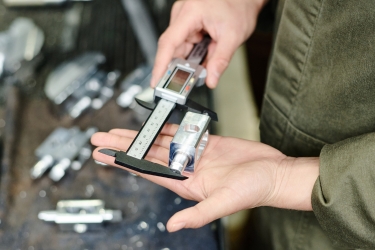
Complex geometries introduce an additional layer of risk, especially as tolerances tighten and multiple operations are involved.
Reducing defects in complex parts is not about inspection alone. It’s about how the process is built.
Key Indicators of a Reliable Supplier
- Defined in-process inspection points, not just final inspection
- First article inspection (FAI) tied to controlled documentation
- Consistent use of calibrated measurement equipment
- Clear separation and handling of nonconforming material
This often becomes an issue when suppliers rely too heavily on final inspection rather than controlling the process upstream.
From a procurement perspective, you should be asking:
- How does the supplier ensure consistency across production runs?
- What happens when a dimension trends out of tolerance mid-run?
Failure containment and lot isolation should be clearly defined, not improvised.
Material and Subcontracting Risk
Material shortages and subcontracted processes are two of the most overlooked risk areas.
Material Risk
Material issues typically show up as:
- Delayed deliveries due to sourcing constraints
- Substitutions without proper approval
- Missing or incomplete traceability
To mitigate this:
- Confirm material sourcing strategies
- Verify traceability to the heat lot or batch
- Ensure material certifications align with requirements
Subcontracting Risk
Many precision parts involve secondary operations such as:
- Plating
- Heat treatment
- Passivation
The risk is not just the process itself, but the lack of visibility.
Ask:
- Are subcontractors approved and documented?
- Is there traceability through each process step?
- Who owns quality responsibility for subcontracted work?
The impact of subcontracted processes is often underestimated until a failure occurs and no one can clearly trace the source.
Total Cost of Ownership vs. Piece Price
One of the biggest lessons in procurement is that the lowest quote rarely represents the lowest cost.
Total cost of ownership includes:
- Scrap and rework costs
- Expedited shipping due to delays
- Engineering time spent resolving issues
- Audit findings and compliance risks
In real scenarios, I’ve seen low-cost suppliers become the most expensive option once quality and delivery issues are factored in.
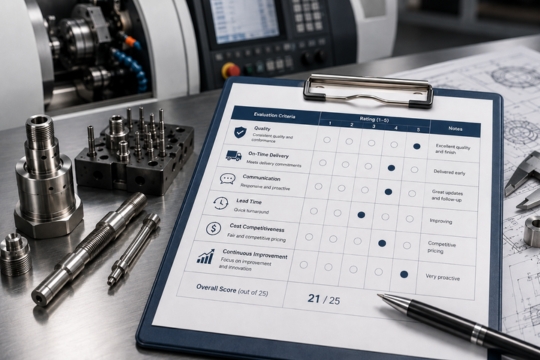
Questions to Ask During Evaluation
- How consistent is their delivery performance?
- What is their historical defect rate?
- How responsive are they to corrective actions?
Manufacturing reliability is what ultimately protects your cost structure.
Building Supply Chain Resilience
Supply chain resilience is not built overnight. It comes from consistent supplier management and proactive planning.
Best Practices
Regular Supplier Reviews
- Monitor delivery performance
- Track nonconformance trends
- Review corrective actions
Contingency Planning
- Identify backup suppliers
- Maintain updated documentation packages
- Ensure tooling and fixtures are not locked to one source
Cross-Functional Collaboration
- Quality and engineering often review supplier performance data
- Engineering may request process validation for critical components
- Procurement ensures those requirements are contractually enforced
Cross-functional review helps prevent blind spots that procurement alone might miss.
Common Pitfalls to Avoid
Even experienced buyers can fall into these traps:
- Selecting suppliers based solely on price
- Skipping detailed documentation reviews
- Assuming certifications guarantee performance
- Ignoring subcontractor risks
- Failing to plan for supply disruptions
In practice, these issues rarely show up immediately. They surface when production demand increases or when something goes wrong.
Conclusion
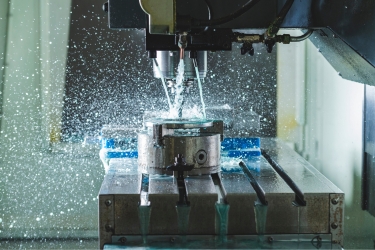
Reducing risk in precision machining procurement is not about eliminating uncertainty entirely. It’s about making informed decisions that account for real-world variables.
When you focus on process control, documentation integrity, and supplier reliability, you position yourself to reduce procurement risk in precision machining environments that depend on it.
Over time, your role evolves from placing orders to actively shaping supply chain stability. You become the person who prevents problems before they happen, not just reacts to them.
If you’re evaluating suppliers or looking to strengthen your sourcing strategy, take the time to review their full machining and assembly capabilities. That visibility is often the difference between a supplier that looks good on paper and one that performs consistently in production.