.png)
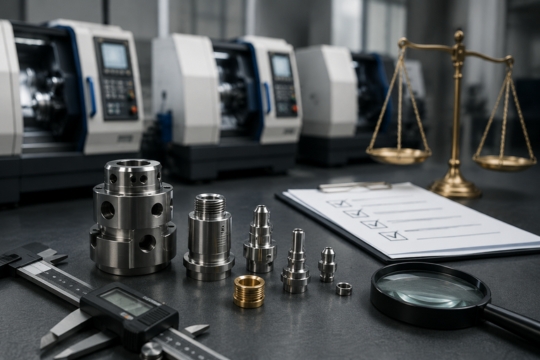
Selecting a Swiss machining supplier for a medical device project is rarely as simple as comparing quotes. On paper, two vendors may appear equally qualified. Both may offer competitive pricing, acceptable lead times, and modern equipment. Yet once production begins, the differences between those suppliers often become apparent through documentation quality, process consistency, communication, and their ability to manage risk.
If you're researching how to compare Swiss machining vendors for medical device manufacturing projects, it's important to recognize that the lowest price rarely represents the lowest total cost. Procurement decisions affect regulatory compliance, product quality, production schedules, and ultimately patient safety. Choosing the wrong supplier can result in delayed product launches, costly corrective actions, or supplier transitions that consume months of engineering and quality resources.
In my experience, the most successful purchasing professionals evaluate suppliers the way quality auditors do. Price certainly matters, but it should never outweigh evidence that a supplier can consistently manufacture compliant components while supporting your organization's long-term objectives.
This article explains the supplier evaluation criteria I believe deserve the greatest attention, where procurement teams often make costly mistakes, and how you can confidently compare machining vendors beyond the numbers shown on a quotation.
Start With the Quality System, Not the Machine List
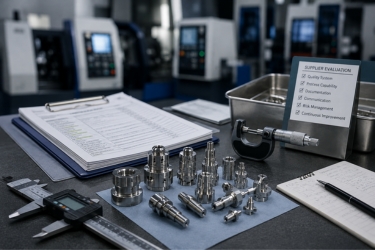
Many suppliers proudly showcase their latest Swiss CNC turning equipment, multi-axis machining capabilities, and automated production cells. While those investments certainly matter, sophisticated equipment alone does not guarantee consistent medical component quality.
From a procurement perspective, I would always evaluate the quality management system before becoming impressed by the equipment list.
A mature supplier should demonstrate:
- ISO 9001 and ISO 13485 certification
- Controlled documentation procedures
- Revision-controlled work instructions
- Production travelers that follow every operation
- Material traceability to heat lot or batch
- Certificates of conformance for finished products
- Clearly defined record retention policies
These elements indicate that quality has been integrated into the manufacturing process rather than relying solely on final inspection. Strong medical machining traceability should allow your team to connect finished components back to the applicable material heat lot or batch, production traveler, inspection records, and any subcontracted processes. That level of control becomes especially important when quality teams need to isolate affected lots, investigate a nonconformance, or respond to an audit request.
When procurement and engineering align early during supplier qualification, documentation maturity often becomes one of the strongest predictors of long-term performance. Engineering may focus on machining capability, while procurement should verify that the supporting quality system can consistently reproduce that capability over thousands of production cycles.
Procurement Insight: One thing I've learned over the years is that documentation discipline often predicts future supplier performance more accurately than equipment capability. Machines can be purchased. A mature quality culture takes years to develop.
Look for Evidence of Process Stability
Medical device manufacturing depends on repeatability.
The supplier's ability to produce one acceptable part is far less important than producing thousands of identical parts over multiple production runs without introducing unnecessary variation.
When evaluating vendors, ask how they maintain process consistency throughout production.
Areas worth reviewing include:
- Machine repeatability monitoring
- Tool life management practices
- Fixture stability
- Set up sheet standardization
- Changeover procedures
- Preventive maintenance schedules
- In-process inspection checkpoints
A supplier should also be comfortable discussing First Article Inspection (FAI), calibration control, inspection metrology, and documented operation sequences without hesitation.
If I had to prioritize one manufacturing capability beyond basic machining competence, production repeatability would rank near the top. Medical component tolerances frequently leave very little room for process drift, making consistency significantly more valuable than maximum production speed.
Evaluate Their Approach to Risk Management

Every manufacturing operation encounters unexpected issues.
The difference between average suppliers and exceptional suppliers is rarely whether problems occur. Instead, it's how quickly those problems are identified, contained, documented, and corrected.
Ask prospective vendors questions such as:
- How are nonconforming parts isolated?
- How are undocumented process changes prevented?
- What triggers a CAPA investigation?
- How are subcontracted processes controlled?
- How is lot containment handled if an issue is discovered?
The answers reveal far more than technical capability. They demonstrate organizational maturity.
I've seen purchasing teams become overly focused on delivery performance while overlooking weak corrective action systems. Unfortunately, many supplier problems don't become visible until months after production has already started. At that point, changing suppliers becomes significantly more expensive than conducting a thorough qualification process upfront.
From a procurement perspective, the biggest risk I see is assuming that a supplier's current success automatically predicts future performance. Strong risk management processes provide confidence that the supplier can recover quickly when unexpected challenges arise.
Don't Let Lead Time Overshadow Long-Term Reliability
Short lead times often receive considerable attention during supplier selection, particularly when project schedules are aggressive.
However, evaluating lead time without understanding how those commitments are achieved can be misleading.
Questions worth asking include:
- Is the quoted capacity based on existing machine availability?
- Are additional shifts required?
- What contingency plans exist for equipment downtime?
- How are schedule changes communicated?
- How are expedited orders prioritized?
Some suppliers consistently quote aggressive delivery schedules by operating with very little production flexibility. Others intentionally provide realistic lead time estimates while maintaining reserve capacity to accommodate engineering changes or unexpected customer requirements.
One recommendation I often make is to value predictability over optimism. A supplier who consistently delivers within an agreed window often creates far fewer disruptions than one who repeatedly promises unrealistic delivery dates.
Procurement Insight: Over the years, I've noticed that reliable communication becomes just as valuable as reliable machining. Production schedules occasionally change. Honest conversations about those changes build far more trust than unrealistic promises.
Assess Technical Collaboration, Not Just Manufacturing Capability
Medical device procurement rarely operates independently.
Quality, manufacturing engineering, supplier quality engineering, regulatory affairs, and design engineering all influence supplier selection decisions.
The strongest suppliers understand this dynamic.
Rather than simply accepting drawings for quotation, experienced vendors frequently ask thoughtful technical questions regarding tolerances, materials, inspection methods, secondary operations for medical parts, and documentation expectations.
This collaborative approach helps prevent misunderstandings before production begins.
For example, quality and engineering often review inspection strategies differently than procurement. Engineering may request additional dimensional verification, while procurement focuses on documentation completeness and supplier responsiveness. Cross-functional review helps prevent costly surprises after production has started.
One thing that consistently stands out during supplier evaluations is a vendor's willingness to engage in technical discussions without immediately turning every conversation into a sales presentation.
Compare the Entire Vendor Qualification Process
A polished quotation package is helpful, but it should never replace a structured vendor qualification process.
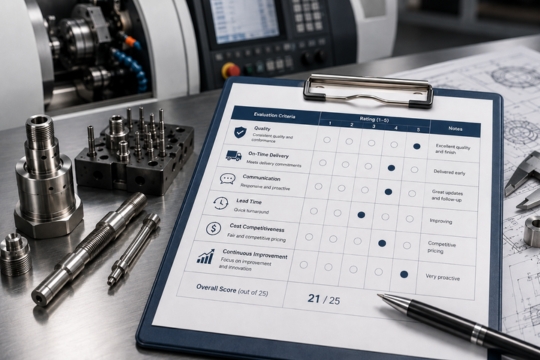
When you're determining how to compare Swiss machining vendors for medical device manufacturing projects, the most reliable approach is to use a structured vendor qualification process rather than relying on first impressions or quoted pricing. Comparing high-volume Swiss machining shops requires gathering objective evidence from multiple sources. Before awarding business, I recommend evaluating suppliers across several categories rather than relying on a single score or subjective impression.
Comparing high-volume Swiss machining shops requires gathering objective evidence from multiple sources. Before awarding business, I recommend evaluating suppliers across several categories rather than relying on a single score or subjective impression.
A comprehensive vendor qualification process should include:
- Quality system certifications and audit history
- Experience in manufacturing similar medical components
- Inspection metrology capabilities
- Material sourcing and traceability controls
- Production capacity and scheduling flexibility
- Secondary operations for medical parts
- Technical support for device engineering
- Financial stability and long-term business viability
- Customer references within regulated industries
- Responsiveness during the quoting process
Not every supplier will excel in every area, but this is often where the best suppliers set themselves apart. Their strengths are usually consistent across quality, communication, engineering support, and operational discipline, rather than concentrated in a single area.
If you're short on time, focus on the factors that are most difficult for a supplier to improve quickly: quality culture, documentation control, and process maturity. Production capacity can often be expanded. Organizational discipline usually cannot.
Procurement Insight: One mistake I've seen repeatedly is allowing an impressive facility tour to outweigh objective evidence. Clean production floors and modern equipment create a positive first impression, but documented processes are what consistently deliver compliant products.
Consider the Total Cost of Ownership, Not Just Piece Price

Competitive pricing naturally attracts attention during supplier selection. However, experienced purchasing professionals know that quoted piece price represents only one portion of the total procurement cost.
Additional costs may include:
- Incoming inspection requirements
- Supplier quality audits
- Engineering support during development
- Expedited freight resulting from missed deliveries
- Production downtime caused by quality issues
- Scrap and rework
- Regulatory documentation requests
- Supplier management resources
I've found that suppliers with slightly higher unit pricing frequently deliver lower overall ownership costs because they require fewer corrective actions, less oversight, and significantly fewer production interruptions.
From a procurement perspective, this is where supplier evaluation becomes a strategic decision instead of a purchasing transaction.
When comparing quotations, ask yourself:
- Which supplier is most likely to reduce future risk?
- Which supplier demonstrates consistent process control?
- Which supplier would engineering and quality be most comfortable working with over the next five years?
Those questions often lead to a different conclusion than comparing price alone.
Watch for Early Warning Signs During the Quoting Process
The supplier evaluation process begins long before the first purchase order is issued.
In practice, the quoting phase often reveals how a supplier will perform after production begins.
Pay close attention to whether the supplier:
- Requests clarification when drawings are ambiguous
- Identifies manufacturability concerns proactively
- Explains assumptions instead of making them
- Documents revision levels correctly
- Responds promptly to technical questions
- Clearly defines what is included in the quotation
Conversely, several warning signs deserve careful consideration:
- Incomplete or inconsistent documentation
- Vague answers regarding inspection methods
- Reluctance to discuss subcontracted processes
- Unclear responsibility for secondary operations
- Poor revision control during the quoting stage
- Unrealistically aggressive lead time estimates
The biggest risk I see is assuming these issues will improve after the purchase order is awarded. In reality, the behaviors demonstrated during supplier qualification often continue throughout the business relationship.
One takeaway I'd encourage you to remember is that the quoting process is itself part of the audit. Treat every interaction as evidence of how the supplier manages communication, documentation, and accountability.
Procurement Insight: If I were evaluating a supplier today, I would pay as much attention to the questions they ask as the answers they provide. Curious suppliers tend to uncover potential issues before they become production problems.
Build Long-Term Supplier Relationships Around Trust
Medical device manufacturing depends on long-term partnerships rather than transactional purchasing.
As product families expand, engineering revisions evolve, and production volumes fluctuate, procurement benefits from working with suppliers that understand your quality expectations and business objectives.
The strongest supplier relationships are built on:
- Transparent communication
- Consistent quality performance
- Stable manufacturing processes
- Well-controlled documentation
- Continuous improvement initiatives
- Mutual accountability
Over time, you start to see that trusted suppliers become valuable contributors during new product introductions, design reviews, and production planning discussions. They help identify risks early, recommend practical solutions, and support cross-functional teams without compromising regulatory requirements.
This level of collaboration cannot be established through pricing negotiations alone. It is earned through consistent performance and demonstrated reliability over many production cycles.
Conclusion
Learning how to compare Swiss machining vendors for medical device manufacturing projects requires looking beyond equipment lists, lead times, and quoted pricing. The suppliers that deliver the greatest long-term value are those with disciplined quality systems, proven production repeatability, robust documentation controls, and a culture of continuous improvement.
If I had to prioritize one area I would never compromise on, it would be process maturity. Modern machines can produce exceptional parts, but only mature organizations consistently produce compliant parts, maintain traceability, manage change effectively, and support your team when unexpected challenges arise.
Ultimately, the goal of procurement is not simply to purchase machined components. It is to reduce risk, support regulatory compliance, strengthen cross-functional collaboration, and build supplier relationships that contribute to your organization's long-term success.
As you evaluate potential manufacturing partners, be sure to request complete documentation of ISO 9001 and ISO 13485 certifications along with evidence of their quality systems, traceability controls, and continuous improvement processes. Those documents often provide the strongest indication that a supplier is prepared to support your medical device manufacturing program well beyond the first purchase order.