.png)
A machining supplier can perform well for years and still become a procurement risk surprisingly quickly. Capacity tightens. Material availability changes. A key employee leaves. A subcontractor starts missing commitments. Quality performance declines, or engineering introduces a new part that requires capabilities your current supplier was never expected to provide.
For procurement, the challenge is that you are rarely sourcing only for today's purchase order. Your decisions can affect production continuity, quality, cost, regulatory compliance, and engineering support for years.
That is why how procurement teams can future-proof machining vendor relationships deserves more attention than simply negotiating price and monitoring delivery dates. Future-proofing means developing supplier relationships that can remain dependable as volumes, specifications, risks, and business requirements change.
You cannot eliminate every disruption. You can, however, build relationships with machining vendors that make it easier to identify and manage problems before they become production emergencies.
In my experience, the strongest supplier relationships are not necessarily the ones that never encounter problems. They are the ones where procurement has enough visibility, documentation, communication, and performance history to recognize a developing problem early and respond intelligently.
What Does It Mean to Future-Proof a Machining Supplier Relationship?

Future-proofing a machining vendor relationship means building a sourcing structure that can adapt to changing requirements without unnecessarily increasing the risk to quality, delivery, compliance, or continuity.
That requires looking beyond whether a supplier can produce today's parts.
You should also be asking:
- Can the supplier support changing production volumes?
- How dependent are you on specific machines, personnel, materials, or subcontractors?
- Does the supplier communicate capacity constraints early?
- Can its quality system support increasingly demanding requirements?
- Does it maintain disciplined revision and documentation controls?
- How effectively does it respond to nonconformances?
- Can it provide the required material and lot traceability?
- Will its capabilities support future part families and designs?
- How difficult would it be to qualify an alternate source?
Those questions turn machining vendor management from a purchasing activity into a risk-management discipline.
A low piece price has limited value if you eventually have to expedite material, replace rejected parts, manage repeated corrective actions, or qualify an emergency second source.
Procurement Insight: Future-proofing is not about predicting every possible disruption. It is about choosing suppliers and creating controls that give you more options when something changes.
Which Machining Suppliers Create the Greatest Procurement Risk?
Not every machining supplier deserves the same level of oversight.
A relatively low-spend supplier can represent a significant risk if it produces a critical component with few qualified alternatives. Conversely, a high-spend supplier producing readily sourced parts may be easier to replace.
For strategic sourcing for precision parts, I recommend evaluating supplier risk using factors such as:
- Part criticality
- Availability of alternate suppliers
- Qualification difficulty
- Quality and delivery performance
- Capacity constraints
- Material availability
- Documentation and traceability requirements
- Dependence on subcontractors
- Requalification costs and lead time
If I had to prioritize, I would pay the closest attention to suppliers that combine high part criticality with limited replacement options. Those relationships can become expensive very quickly when performance deteriorates.
Use a Practical Supplier Risk Matrix
A supplier risk matrix for CNC parts does not need dozens of variables.
Start with two basic questions:
How likely is a meaningful disruption or performance failure?
How serious would the impact be if it occurred?
Then consider how difficult recovery would be. A component requiring specialized tooling, extensive first article inspection, special processing, or customer approval may take considerably longer to transfer than a conventional part with multiple qualified sources.
This is also where procurement should work closely with engineering and quality. Cross-functional review helps uncover risks that may not be obvious from purchasing data alone.
Understanding these dependencies is an important part of mitigating precision machining procurement risks before a disruption occurs.
How Can Procurement Improve Supply Chain Transparency?
One of the strongest foundations for a resilient supplier relationship is supply chain transparency.
You need enough visibility to understand not only whether your purchase order is on schedule, but also what could prevent it from staying on schedule.
For strategic machining suppliers, that may include visibility into:
- Current production status
- Available machine capacity
- Material lead times
- Critical tooling requirements
- Outside processing
- Inspection bottlenecks
- Upcoming shutdowns or maintenance
- Important sub-tier dependencies
You do not need access to every internal detail of a supplier's operation. You need enough information to make informed procurement decisions.
For example, there is a meaningful difference between a supplier saying, "Your parts will ship Friday," and explaining that material has arrived, machining is underway, outside processing is scheduled, and final inspection is planned for Thursday.
The second response gives you information you can evaluate.
Understand Subcontractor Dependencies
Outside processing is one area I would never overlook.
Depending on the component, a machining supplier may rely on outside sources for heat treatment, plating, passivation, grinding, coating, or other special processes.
Ask which processes are subcontracted, how those suppliers are approved and monitored, whether alternate approved sources exist, and how subcontractor documentation is controlled.
The issue is not subcontracting itself. Many capable machining suppliers use specialized processors.
The risk is discovering too late that a critical part depends on a single outside source.
That visibility should be part of your CNC supplier risk mitigation strategy.
Procurement Insight: A supplier who tells you about a potential problem early gives you options. A supplier hiding the same problem until the due date is taking away your options.
Which Vendor Performance Metrics Matter Most?
Supplier relationships become difficult to manage when expectations are subjective.
"Quality has been pretty good," or "delivery seems to be slipping," does not provide enough information for a meaningful supplier review.
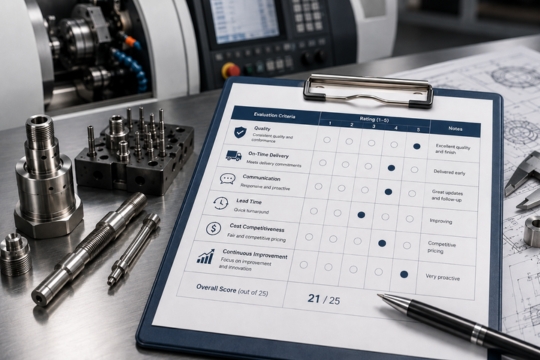
A structured vendor performance evaluation gives procurement and the supplier a common set of facts.
Useful contract manufacturing vendor key performance indicators can include:
- On-time delivery
- Defect or nonconformance rate
- Corrective action responsiveness
- Documentation accuracy
- Lead-time adherence
- First article acceptance
- Quote responsiveness
- Premium freight or expedited frequency
Not every supplier requires the same scorecard. The metrics should reflect the risk associated with the purchased parts.
Focus on Performance Trends

One late order does not necessarily indicate an unreliable supplier. A pattern does.
The same principle applies to quality.
A single nonconformance that is properly contained, investigated, and followed by effective corrective action can demonstrate that the supplier's quality system is working. Repeated problems with similar root causes are more concerning.
One thing I've learned over the years is that supplier performance often deteriorates gradually. You may see slightly longer response times, more requests to move delivery dates, incomplete documentation, or recurring minor quality problems before a major failure occurs.
Use the scorecard as an early-warning system, not simply a report card.
Procurement Insight: The value of supplier KPIs is not the score itself. Their greatest value is showing you when the direction of supplier performance is changing.
How Should Procurement Evaluate Process and Documentation Controls?
Procurement does not need to become the machining expert. Engineering and supplier quality provide important technical support.
You should, however, understand the indicators of a controlled manufacturing process.
A capable supplier should be able to demonstrate discipline through areas such as:
- Controlled production routing and travelers
- Current setup sheets and operation sequences
- Revision control
- Defined in-process inspection points
- Calibration control
- First article inspection
- Nonconformance handling
- CAPA and root cause analysis
- Record retention
- Material and lot traceability
- Certificates of conformance
Why does this matter to purchasing?
Because machining capability without process discipline can become unpredictable.
A supplier may successfully produce an initial order but struggle to repeat that result months later if tooling, setups, documentation, or inspection controls are poorly maintained.
Machine repeatability matters, but organizational repeatability matters too.
Pay Attention to Process Changes
Equipment, tooling, production routing, facilities, and subcontractors can change over the life of a program.
Not every change creates risk, but changes affecting controlled requirements should follow appropriate notification and approval procedures.
When procurement and engineering align early on change-control expectations, you reduce the risk of discovering after delivery that an important process change occurred without review.
From a procurement perspective, I would place strong documentation and change control above a marginal piece-price advantage. Small unit-cost savings can disappear quickly when poor controls lead to rework, inspections, delays, or corrective actions.
How Can Procurement Build Stronger Long-Term Supplier Relationships?
Supplier relationship management should not begin when something goes wrong.
For strategic machining suppliers, regular communication should cover more than open purchase orders. Discuss upcoming demand, performance, capacity, material concerns, and potential constraints.
Where appropriate, provide visibility into:
- Expected volumes
- New product introductions
- Anticipated production increases
- Engineering changes
- Seasonal demand
- Potential large releases
Forecasts may not represent firm commitments, but directional visibility helps suppliers plan machine capacity, labor, materials, and tooling.
Communication should also work in the opposite direction.
You want suppliers to raise concerns early. If a supplier anticipates a capacity or material problem six weeks from now, procurement has options. If you hear about it on the delivery date, most of those options are gone.
This does not mean lowering performance expectations. It means building a relationship in which risks can be discussed early enough to address them.
Should Procurement Dual-Source Critical Machined Components?
Future-proofing does not mean dual-sourcing every component.
Maintaining multiple qualified suppliers can increase qualification costs, tooling expenses, administrative workload, minimum-order requirements, and overall complexity. Splitting volume may also make your business less attractive to either supplier.
Instead, evaluate single-source exposure deliberately.
Ask:
- How critical is the component?
- How difficult would it be to qualify another supplier?
- How long would the qualification take?
- Does specialized tooling create a switching barrier?
- Are materials readily available?
- Are there regulatory or customer approval requirements?
- Could another supplier manufacture the part if necessary?
- How much inventory would be required to bridge a disruption?
For high-risk components, maintaining a qualified secondary source may be justified.
For lower-risk parts, maintaining current documentation, tooling information, potential alternate suppliers, and a contingency plan may provide sufficient protection.
If you're short on time, start with the components that would be hardest to replace. Ask engineering and quality what would be required to transfer each one to another supplier.
That exercise often exposes dependencies that procurement did not realize existed.
Why Does Total Cost of Ownership Matter in CNC Procurement?
Future-proof supplier relationships cannot be built around unit price alone.
Total cost of ownership in CNC procurement provides a better framework for evaluating the financial impact of supplier performance.
Consider costs associated with:
- Incoming inspection
- Rejected material
- Rework and sorting
- Premium freight
- Production downtime
- Corrective action administration
- Engineering support
- Documentation errors
- Excess inventory
- Supplier qualification
- Expedites
Suppose Supplier A quotes a component at $8.70 and Supplier B quotes $9.05. The lower quote initially appears to be the obvious choice.
But if Supplier A has inconsistent delivery, requires additional incoming inspection, and causes recurring documentation issues, the $0.35 savings can disappear quickly.
Your CNC machining procurement strategy should therefore ask a broader question:
Which supplier gives the organization the most reliable long-term economic outcome?
That is a much more useful sourcing question than simply asking who submitted the lowest quote.
How Often Should Procurement Reassess Machining Supplier Risk?
Supplier qualification should not be treated as permanent.
Businesses change. Ownership changes. Employees leave. Equipment ages. Demand increases. Subcontractors change. Material markets tighten.
For important machining suppliers, periodically reassess risk and watch for warning signs such as:
- Increasing lead times
- Frequent delivery-date changes
- Declining quality performance
- Repeated documentation errors
- Slow corrective action responses
- Reduced communication
- Unexpected personnel or ownership changes
- Unexplained process changes
- Capacity limitations
None of these automatically means you should replace the supplier.
They do mean you should investigate.
I've seen purchasing teams wait until a supplier fails a major metric before increasing oversight. By that point, corrective options are usually more expensive.
Quality, engineering, and procurement should review high-risk suppliers together because each function sees different warning signs. Engineering may notice manufacturing concerns, quality may identify recurring nonconformances, and procurement may see changing lead times or communication patterns.
Together, those signals provide a much better picture of supplier health.
What Separates a Strategic Machining Supplier From a Transactional Vendor?

The strongest supplier relationships should become more valuable over time.
A strategic supplier learns what matters to your organization. Your procurement team learns where the supplier performs best. Engineering becomes familiar with its manufacturing capabilities, while quality develops confidence in its controls and responsiveness.
That accumulated knowledge can reduce sourcing risk.
Look for suppliers that consistently demonstrate:
- Reliable delivery
- Quality consistency
- Documentation discipline
- Transparent communication
- Effective problem solving
- Capacity planning
- Responsiveness
- Continuous improvement
Not every supplier will excel in every area. The important distinction is whether the supplier merely fulfills purchase orders or actively helps your organization manage risk.
Those are not the same thing.
For important parts and programs, the second type of supplier is usually more valuable over the long term.
Future-Proofing Starts Before the Next Disruption
Understanding how procurement teams can future-proof machining vendor relationships ultimately comes down to building resilience before you need it.
If I had to prioritize, I would focus on four areas: identify which components and suppliers create the greatest continuity risk, establish meaningful performance measures, improve visibility into capacity and subcontractor dependencies, and maintain realistic contingency options for parts that would be difficult to replace.
Then look beyond what a supplier promises during the sourcing process. Pay attention to the systems and behaviors that indicate whether the relationship can support you over time: controlled documentation, traceability, process consistency, transparent communication, effective corrective action, reliable delivery, and a willingness to plan ahead with your team.
When those elements are present, procurement moves beyond managing purchase orders. You are building supplier relationships designed to withstand change.
As you evaluate existing vendors or qualify new sources, explore precision machining capabilities with an eye toward the manufacturing processes, quality controls, documentation, and capacity that can support your requirements today and as those requirements evolve.