.png)
When a machining supplier is performing well, evaluation can feel straightforward. Parts arrive on time, inspection results are acceptable, documentation is complete, and there are few complaints from engineering or quality.
The real procurement challenge begins when performance becomes inconsistent.
A shipment arrives late. Another is missing a material certification. A dimensional nonconformance appears during inspection. The supplier responds, but a similar issue returns a few months later.
At that point, you need more than impressions. You need objective performance data.
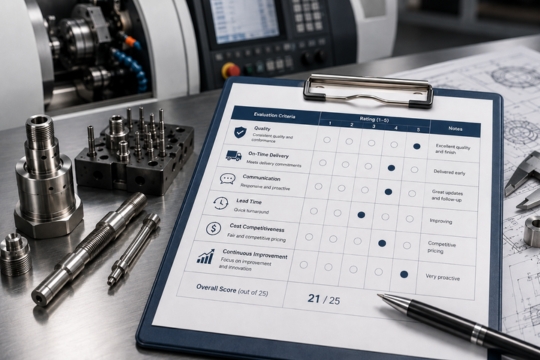
A supplier scorecard for machining vendors gives you a structured way to measure quality, delivery, documentation, corrective action, and commercial performance over time. For precision machining suppliers, the most useful scorecards help you identify patterns before isolated problems become sourcing risks.
In my experience, the best scorecards are not the ones with the most measurements. They are the ones that make supplier risk easier to see and sourcing decisions easier to defend.
What Is a Supplier Scorecard for a Machining Vendor?

A machining supplier scorecard is a structured evaluation system used to measure a machine shop's performance against defined procurement, quality, delivery, compliance, and commercial criteria.
Instead of judging a supplier based on a single purchase order or a recent problem, a scorecard builds a performance history.
That history can help you determine:
- Whether quality is improving or deteriorating
- Whether delivery problems are isolated or recurring
- Whether documentation is consistently complete
- Whether corrective actions actually prevent recurrence
- Whether the supplier is creating hidden costs
- Whether the supplier deserves additional business
- Whether you should begin developing a second source
A scorecard should not exist simply to assign a supplier a numerical grade. Its purpose is to support better sourcing decisions.
Procurement Insight: If a scorecard metric never influences supplier development, sourcing strategy, risk mitigation, or future awards, consider whether it is worth tracking.
Why Are Supplier Scorecards Important in Precision Machining?
Supplier scorecards are valuable because machining supplier risk often develops gradually.
A supplier may still appear acceptable even as small problems begin to accumulate. On-time delivery slips several points. Documentation errors become more frequent. A few minor nonconformances appear. Corrective actions begin taking longer.
Individually, none of these issues may seem serious. Together, they can indicate that supplier performance is deteriorating.
Machine shop performance tracking helps you connect those events.
This matters in precision machining because supplier performance depends on more than whether a machine can make a part to print. Production routing, tooling and fixture stability, machine repeatability, inspection controls, documentation, and subcontracted processes can all influence consistency.
Procurement does not need to manage those processes. You do need enough visibility to recognize when a supplier is becoming less reliable.
What KPIs Should You Include in a Machining Supplier Scorecard?
The most useful machining supplier KPIs generally fall into five categories:
- Quality
- On-time delivery
- Documentation and compliance
- Corrective action effectiveness
- Commercial performance
If I had to prioritize, I would generally put quality first, followed by delivery. Documentation and corrective action become especially important when you are sourcing regulated or tightly controlled components.
Commercial performance matters, but price should never compensate for unacceptable quality or compliance risk.
Which CNC Machining Quality Metrics Matter Most?
CNC machining quality metrics should measure both the frequency and recurrence of supplier-caused problems.
Common metrics include:
- Rejected lots
- Nonconforming parts
- Supplier-caused NCRs
- First article inspection acceptance
- Repeat nonconformances
- Customer returns
- Corrective action frequency
- Defect rate or parts per million
A basic part defect rate calculation in manufacturing is the number of defective parts divided by the total number of parts received, multiplied by 100.
The calculation is simple. The interpretation is more important.
Ten defective parts in a shipment of 10,000 are very different from ten defective parts in a shipment of 100. Likewise, a minor cosmetic issue does not carry the same risk as a dimensional failure affecting fit, function, or a critical requirement.
One mistake I've seen repeatedly is focusing on the defect count without considering recurrence. A supplier that has one problem and permanently corrects it may represent less risk than a supplier with smaller but repeated failures.
Repeat problems can point to weaknesses in process consistency, setup control, tooling stability, inspection, or root cause analysis.
From a procurement perspective, recurrence deserves significant attention.
How Should You Measure On-Time Delivery?

Machine shop on-time delivery should be measured against one clearly defined delivery commitment and applied consistently.
A common calculation is:
On-Time Delivery Percentage = Orders Delivered On Time ÷ Total Orders Due × 100
The more important question is what your organization considers "on time."
Possible reference points include:
- Purchase order due date
- Supplier-confirmed date
- Required dock date
- Shipment date
- Actual receipt date
Choose one methodology and document it.
You should also define how partial shipments, approved schedule changes, and customer-requested delays are handled.
I've found that delivery trends often tell you more than a single month's percentage. A supplier moving from 99% to 96% to 93% to 90% is giving you an early warning, even if 90% is still technically acceptable.
Recurring delays may indicate capacity constraints, material shortages, production scheduling problems, changeover demands, or delays involving subcontracted processes.
You do not need to diagnose the manufacturing issue yourself. You need to determine whether the supplier understands the cause and has a credible plan to correct it.
Procurement Insight: Do not wait for an on-time delivery KPI to cross a formal failure threshold. A sustained downward trend is already useful risk information.
Should Documentation Performance Be Included?
Yes. Documentation performance should be measured whenever certifications, traceability, inspection records, or controlled manufacturing records are part of your requirements.
A machining order is not necessarily complete simply because the physical parts arrived.
Depending on the component, you may also require:
- Certificates of conformance
- Material certifications
- Heat lot or batch traceability
- Inspection records
- First article inspection documentation
- Special process certifications
- Subcontractor documentation
- Revision-controlled records
A supplier can manufacture conforming components yet still pose a significant risk due to weak documentation controls.
For medical components, this scorecard monitoring should complement the controls you already use in a medical device supplier audit checklist.
The two tools serve different purposes. An audit evaluates whether systems and controls exist and are being followed. A scorecard shows how the supplier performs through actual purchasing activity over time.
Together, they give procurement a more complete view of supplier risk.
How Should Corrective Actions Affect the Score?
Corrective action performance should be evaluated based on containment, root cause quality, implementation, and recurrence, not simply response speed.
A supplier may acknowledge a complaint within hours and still fail to identify the underlying cause.
Useful measures include:
- Initial response time
- Failure containment
- Lot isolation
- Root cause determination
- Corrective action completion
- CAPA closure when applicable
- Recurrence of the same or related issue
When a significant quality problem occurs, immediate containment and lot isolation may matter more than receiving a polished report quickly.
The strongest indicator is whether the supplier prevents the problem from happening again.
In practice, I recommend treating repeated nonconformances more seriously than modest delays in administrative response time.
A corrective action that is closed on paper but fails to prevent recurrence has not solved the problem.
How Much Weight Should Price Receive?
Price belongs on a machining supplier scorecard, but it should generally receive less weight than quality, delivery, and compliance for critical precision components.
The lowest unit price does not necessarily mean the lowest total cost.
Commercial performance should also consider:
- Quote accuracy
- Pricing consistency
- Unexpected surcharges
- Expedite costs
- Freight costs
- Minimum-order requirements
- Lead-time stability
- Cost of supplier quality problems
- Administrative burden
A supplier offering a lower piece price may become the more expensive option if it repeatedly creates expedited freight, receiving holds, sorting activity, corrective actions, or additional engineering involvement.
That is why manufacturing vendor evaluation should consider the total cost of ownership, not purchase price alone.
How Should You Weight Machining Supplier KPIs?

A supplier scorecard for machining vendors should weight performance according to the consequences of supplier failure.
There is no universal procurement scorecard template.
For a precision machining supplier, a practical approach is to place the greatest emphasis on quality, followed by delivery, documentation, compliance, corrective action, and commercial performance.
The exact percentages should reflect your products, regulatory requirements, supply chain risks, and internal priorities.
More importantly, certain events should override the numerical score.
Examples include:
- Serious traceability failures
- Unauthorized process changes
- Repeated critical nonconformances
- Ineffective corrective actions
- Missing required material documentation
- Breakdown of controlled records
- Failure to control subcontracted processes
These issues may justify escalation even when the supplier's overall score remains acceptable.
Procurement Insight: Never allow scorecard mathematics to dilute a serious quality or compliance problem. Some supplier risks should trigger review regardless of the weighted average.
How Often Should Machining Suppliers Be Reviewed?
High-risk or strategically important machining suppliers should be reviewed more frequently than low-risk suppliers.
For key suppliers, quarterly reviews often provide more useful information than waiting for an annual evaluation.
The most important thing is to look at trends.
A supplier currently scoring 86 may be improving from 74, 79, and 83, or declining from 96, 93, and 89. The current score is the same, but the sourcing implications are very different.
Trend analysis can include:
- Monthly or quarterly performance
- Rolling 12-month performance
- Performance by part family
- Performance by facility
- Performance by quality issue category
When procurement and engineering align early, they can determine whether declining performance is primarily commercial, operational, or technical.
Quality can also provide context around nonconformances, calibration control, inspection results, CAPA, and documentation issues that may not be visible in purchase order data.
Cross-functional review helps prevent procurement from seeing a satisfactory price and delivery picture while engineering or quality sees increasing manufacturing risk.
What Should You Do When a Supplier's Score Declines?
A declining supplier score should trigger an action proportionate to the severity and risk of the problem.
Possible responses include:
- Supplier performance review
- Increased incoming inspection
- Formal corrective action
- Supplier development
- Additional audit activity
- Reduced order allocation
- Second-source qualification
- Temporary probation
- Removal from future sourcing consideration
The response should depend on what is driving the decline.
A minor documentation issue does not necessarily justify the same reaction as repeated dimensional nonconformances or loss of material traceability.
Likewise, a single late shipment caused by an unusual disruption may not carry the same risk as six months of steadily deteriorating delivery performance.
If you're short on time, focus your supplier-management resources on the vendors whose failure would create the greatest consequences for production, quality, regulatory compliance, or continuity of supply.
Your monitoring effort should follow your procurement risk.
What Are the Most Common Supplier Scorecard Mistakes?
The most common supplier scorecard mistakes are tracking too many metrics, weighting everything equally, measuring inconsistently, relying too heavily on averages, and failing to connect scores to action.
Tracking Too Many KPIs
More data does not automatically produce better sourcing decisions.
Focus on metrics directly connected to quality, delivery, compliance, cost, and risk.
Giving Every Metric Equal Importance
A late quotation and a traceability failure are not equivalent procurement risks.
Weight performance accordingly.
Measuring Suppliers Inconsistently
If buyers use different definitions for on-time delivery or defect classification, your comparisons become unreliable.
Define each KPI and calculation method.
Looking Only at the Average
Averages can hide serious individual events or deteriorating performance.
Always review severity, recurrence, and trend direction alongside the overall score.
Using Scorecards Only When Something Goes Wrong
Scorecards should identify both improvement and deterioration.
Consistent improvement after corrective action can increase confidence in a supplier and support future sourcing decisions.
How Can a Scorecard Help You Choose Between Machining Vendors?
A scorecard helps you compare machining vendors using documented performance rather than price, relationships, or isolated experiences.
When evaluating existing suppliers for future business, ask:
- Is quality stable?
- Are nonconformances isolated or recurring?
- Is on-time delivery improving or declining?
- Are the required records complete and revision-controlled?
- Can materials be traced to the required heat lot or batch?
- Are certificates of conformance consistently accurate?
- Does the supplier maintain appropriate first article and in-process inspection controls?
- Are subcontracted processes documented and controlled?
- Does the supplier contain failures effectively?
- Are corrective actions supported by credible root cause analysis?
- Does the supplier communicate scheduling or capacity risks early?
One thing I've learned over the years is that reliable suppliers usually make themselves easier to evaluate.
Their records are organized. Their explanations are consistent. When a problem occurs, they can identify the affected product, explain what happened, and describe what they are doing to prevent recurrence.
That transparency should increase your confidence.
Repeated excuses, inconsistent information, missing records, undocumented changes, or resistance to performance reviews should have the opposite effect.
Turn Supplier Performance Into Better Sourcing Decisions
The real value of a machining supplier scorecard is not the final number. It is the evidence it gives you when deciding where to place business and where to reduce risk.
For precision machining procurement, I would prioritize quality first, followed by delivery reliability, documentation and compliance, corrective action effectiveness, and commercial performance. Exact weighting will vary, but serious quality, traceability, and compliance problems should never be masked by a favorable average.
Look beyond today's score. Evaluate performance trends, repeat failures, corrective action effectiveness, documentation consistency, and the supplier's willingness to communicate emerging risks.
Then combine those results with supplier audits, engineering and quality input, total cost of ownership, and the consequences of a supply interruption.
When you are evaluating a machining partner for complex or tightly controlled components, reviewing its precision Swiss machining capabilities can help you determine whether its manufacturing processes, quality controls, and production resources align with your sourcing requirements.