%2520(4).png&description=Should You Reshore Medical Device Machining?)


An overseas machining supplier offers competitive pricing for a medical-device component, but shipping delays, engineering revisions, and quality issues are making procurement planning more difficult. Even with lower unit costs, managing inventory and coordinating production changes can increase the overall cost of sourcing those components.
This situation often leads manufacturers to consider reshoring precision machining for medical devices. However, transferring production to a U.S.-based supplier involves more than finding a manufacturer that can produce the same component. The new supplier must also meet the necessary technical and quality requirements.
A domestic supplier needs to offer measurable improvements in delivery reliability, quality control, or overall sourcing costs to justify the expense of switching manufacturers. Since U.S.-based production is not automatically cheaper or faster, the first step is identifying which problems with the existing arrangement actually justify looking for another supplier.
When Does Reshoring Medical Machining Make Sense?

Recurring delivery delays, quality issues, and slow supplier communication can make reshoring precision machining for medical devices a more attractive choice, especially when these problems increase costs or disrupt production schedules.
Reshoring means bringing manufacturing previously performed overseas back to the United States. For medical-device manufacturers, onshoring MedTech manufacturing can mean transferring selected components to domestic suppliers without moving an entire production program.
This approach also fits into MedTech supply chain regionalization, where manufacturers spread production across different regions instead of relying on a single location for their component supply.
For procurement teams, the clearest reasons to review domestic suppliers include:
- Unpredictable replenishment: International shipping delays repeatedly interfere with production schedules.
- Frequent engineering changes: Design revisions require repeated coordination with suppliers across different time zones.
- Prolonged quality investigations: Resolving nonconforming components takes longer because of communication delays and coordination across locations.
- High inventory requirements: Manufacturers maintain additional safety stock to account for uncertain replenishment schedules.
- Changing production demand: Existing suppliers struggle to adjust production quantities or delivery schedules when demand changes.
- Geographic concentration: Relying on one overseas manufacturing location leaves component supply vulnerable to disruptions in that region.
What Are the Advantages of Domestic Medical CNC Machining?
The main advantages of reshoring medical precision components include shorter transportation routes, closer supplier communication, and greater flexibility in production planning. However, these benefits of domestic medical CNC machining depend on the supplier's manufacturing capacity, processes, and delivery performance.
Shorter Supply Routes and More Predictable Deliveries
Domestic sourcing eliminates international freight and customs clearance for U.S.-manufactured components, reducing exposure to overseas shipping delays in MedTech machining.
Actual medical device lead time reduction depends on raw material availability, machining capacity, outside processing, and inspection requirements. Procurement teams should compare each supplier's complete production and delivery schedule, not just transportation time.
Closer Quality and Engineering Coordination
Working with a domestic supplier can make facility visits and discussions between procurement, engineering, and quality teams easier to arrange. This can shorten the time spent resolving dimensional discrepancies, clarifying drawing revisions, and investigating rejected components.
For domestic supplier quality control, closer communication helps teams review inspection records, coordinate corrective actions, and clarify documentation requirements without extended exchanges across time zones. These improvements come from faster communication between teams, not from any inherent difference in manufacturing quality.
Greater Flexibility in Production Planning
Working with a domestic supplier can make it easier to coordinate prototypes, initial production runs, and recurring orders, particularly when design changes require tooling adjustments or revised production schedules.
More reliable replenishment can reduce the number of components tied up in production or transit, provided the supplier has enough capacity to meet changing order volumes.
Is Domestic Swiss Machining More Cost-Effective Than Offshore Production?

A lower unit price doesn't always mean a lower sourcing cost. Freight, inventory, quality-related expenses, and supplier qualification costs can change how domestic and offshore machining compare financially.
Compare Total Cost of Ownership, Not Just Unit Price
Total cost of ownership covers the expenses of purchasing components and maintaining their supply, including transportation, inventory, quality-related costs, and other operational expenses.
When calculating the total cost of ownership of reshoring medical machining, procurement teams should account for:
- Component pricing: Unit costs, minimum order quantities, and volume discounts.
- Transportation: Freight, insurance, customs brokerage, and applicable duties or tariffs.
- Inventory: Warehousing, financing, and safety-stock carrying costs.
- Quality: Inspection, scrap, rework, and nonconformance investigations.
- Disruptions: Expedited shipments and costs associated with delayed production.
- Transition: Supplier qualification, tooling, validation, and production ramp-up expenses.
Landed cost includes the purchase price, transportation, and applicable import expenses, while total cost of ownership extends to inventory, quality-related costs, and other operating expenses.
Procurement teams should separate recurring expenses from one-time transition costs when comparing suppliers. For a closer look at how these tradeoffs influence supplier selection, see balancing cost, quality, and lead time in machining.
Compare Domestic Swiss Machining vs. Offshore Manufacturing
The choice between domestic Swiss machining vs offshore manufacturing comes down to the costs and production requirements of each sourcing arrangement.
Domestic sourcing considerations:
- Potentially higher quoted machining prices.
- Shorter shipping routes and easier communication with suppliers.
- Upfront supplier qualification and production-transfer costs.
- Available production capacity and access to required materials.
Offshore sourcing considerations:
- Competitive unit pricing for established production volumes.
- International freight, customs clearance, and applicable import expenses.
- Additional inventory needed to cover longer or less predictable replenishment cycles.
- Existing manufacturing processes and established quality controls.
Consider a precision medical component with a lower quoted price from an overseas supplier. Frequent expedited shipments and substantial buffer inventory could push its total sourcing costs above those of a higher-priced domestic alternative.
If the overseas supplier consistently meets delivery schedules, produces components with few defects, and requires little additional inventory, switching to domestic production becomes harder to justify financially.
What Should You Verify in a Domestic Medical Machining Supplier?
A domestic supplier must demonstrate technical suitability, production capacity, and documented quality capabilities before receiving production approval.
Machining Capability and Production Readiness
US precision Swiss machining can produce small, intricate turned components with tight dimensional tolerances. Its suitability for a medical component depends on the part's geometry, material, tolerance requirements, and production volume.
During supplier qualification, verify:
- Experience machining the specified materials and component geometries.
- Ability to meet dimensional tolerances and surface-finish requirements.
- Availability of suitable machinery, tooling, and inspection equipment.
- Capability to produce prototypes and sufficient capacity for recurring orders.
- Procedures for managing drawing revisions and production schedules.
Quality Systems, Inspection, and Traceability
ISO 13485 certification demonstrates that a machining supplier's quality management system meets requirements specific to medical devices within its certified scope, while ISO 9001 covers broader quality management requirements across industries.
The FDA's revised Quality Management System Regulation (QMSR), effective February 2, 2026, incorporates ISO 13485:2016 by reference. A supplier's ISO 13485 certification does not mean its individual components are approved or that the finished medical device meets all regulatory requirements.
The quality review should cover:
- Current quality management certifications and their scope.
- First Article Inspection, or documented inspection of initial production parts against specified requirements, when required.
- Drawing revision control and controlled manufacturing documentation.
- Material certificates and lot traceability where specified.
- In-process and final inspection procedures.
- Procedures for handling nonconforming components and implementing corrective actions.
For buyers comparing ITAR and ISO 13485 domestic machining supplier requirements, the two serve different purposes. ITAR regulates certain defense-related articles, services, and technical data, while ISO 13485 sets quality management requirements for medical devices. Ordinary medical-device components are not automatically subject to ITAR.
Likewise, AS9102 is an aerospace First Article Inspection standard. Medical-device manufacturers can specify its use in supplier contracts, but it is not a universal requirement for medical-component qualification.
How Can You Reshore Component Production Without Disrupting Supply?
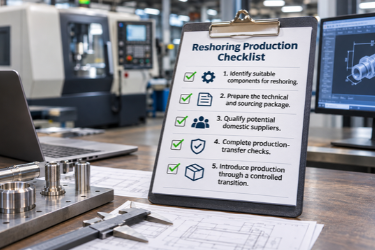
A controlled production transfer is essential to reshoring precision machining for medical devices without creating avoidable supply interruptions. Procurement, engineering, and supplier quality teams should coordinate five steps.
1. Identify suitable components for reshoring.
Start with components affected by recurring delivery delays, high inventory costs, frequent engineering revisions, or slow supplier communication. Use existing supplier performance records to determine which parts should be prioritized.
2. Prepare the technical and sourcing package.
Gather current drawings and revision levels, material specifications, critical dimensions, inspection requirements, expected production volumes, and quality documentation requirements. Providing these details upfront helps prospective suppliers assess manufacturing feasibility and prepare comparable quotations.
3. Qualify potential domestic suppliers.
Review each supplier's machining experience, equipment, certifications, production capacity, and quality procedures, with engineering and supplier quality teams confirming technical feasibility before purchasing approves the new source.
4. Complete production-transfer checks.
Coordinate required first-article inspections, process qualification or validation, documentation reviews, and internal approvals. The supplier change also needs to be reviewed for applicable change-control, regulatory assessment, and notification requirements.
5. Introduce production through a controlled transition.
Start with initial production quantities where appropriate, monitoring component conformity, delivery performance, and process consistency. Maintain sufficient inventory until the new supplier meets the required approval and production-readiness criteria.
Manufacturers with reliable overseas suppliers can use dual sourcing by qualifying a domestic supplier for part of their production. This gives them another source of components, provided both suppliers meet the required quality and capacity standards.
How Do You Decide If Reshoring Is Worth It?
The final sourcing decision needs to be backed by documented supplier performance and manufacturing capabilities. From there, procurement teams have three options:
- Reshore selected components: Move production to a qualified domestic supplier when recurring cost, delivery, or quality problems outweigh the expense of switching manufacturers.
- Adopt dual sourcing: Retain a reliable offshore supplier while qualifying a domestic manufacturer for additional capacity or geographic diversification.
- Retain offshore production: Keep the existing supplier when delivery and quality performance are consistent, pricing remains competitive, and switching would increase costs without improving operations.
Medical Machining Reshoring Decision Checklist
Before approving a sourcing change, confirm that your team has:
- Documented current supplier delivery and quality performance.
- Compared total sourcing costs, including freight, inventory, and quality-related expenses.
- Verified domestic machining capability and capacity.
- Reviewed ISO 13485 certification and required documentation.
- Estimated qualification and production-transfer costs.
- Confirmed engineering and quality approval requirements.
- Evaluated full reshoring, partial reshoring, and dual sourcing.
Document the final recommendation with input from procurement, engineering, quality, and operations.
Weigh Your Domestic Machining Options
Before transferring production, procurement teams need to confirm how the change would affect existing orders, production schedules, and the timing of deliveries from the new supplier.
Swiss Machine Products, based in Anaheim, California, provides Swiss-style precision machining for medical-device components, with capabilities spanning prototyping and production. The company also maintains ISO 9001- and ISO 13485-certified quality management systems.
Procurement teams reviewing domestic suppliers can submit their drawings, material specifications, expected quantities, and production requirements to request a quote to reshore component production.